
How comfortable are minibuses for long trips?
London Minibus Hire explores what makes a minibus genuinely comfortable for long distance group travel, from seating and climate control to emissions compliance in London, Edinburgh, and Glasgow.
You know the real test of minibus hire is not the first 20 minutes. It is hour two, when the cabin temperature drifts, devices run flat, and everyone starts shifting in their seats.
Comfort on long trips comes down to a handful of controllable specs: seating layout, ventilation, suspension, noise levels, and the on-board basics that stop a group from tiring out.
At London Minibus Hire, we break down what to look for, what to ask your operator to confirm, and how to match the vehicle to your route whether you are travelling in London, Edinburgh, Glasgow, or anywhere across the UK.
Key Takeaways
- For long distance group travel, prioritise seat comfort and layout first, then add the extras such as WiFi, USB charging, and tables as needed for your passengers.
- In city centres, emissions compliance can decide your vehicle choice. Transport for London lists ULEZ requirements for minibuses up to 5 tonnes as Euro 6 for diesel and Euro 4 for petrol.
- For Scottish city centres, plan around Low Emission Zones. Edinburgh enforcement began 1 June 2024 and Glasgow LEZ enforcement began 1 June 2023, with buses and coaches typically needing Euro VI standards.
- On longer routes, comfort also means realistic scheduling. DVSA guidance highlights the 45 minute break requirement after up to 4.5 hours of driving under the main passenger vehicle rules.
- Common comfortable long trip setups include 8 seat executive people carriers, 12 to 19 seat minibuses, and 25 to 39 seat midi coaches, with larger coaches for 43 to 53 seats where luggage space and legroom still work for your itinerary.
Key Features That Enhance Minibus Comfort for Long Trips
Vehicles built on popular commercial van platforms can be genuinely comfortable for long trips, provided the conversion and specification are right.
The most helpful way to think about comfort is in layers: the base vehicle (ride quality, noise, engine), the conversion (seat type, insulation, flooring), and the operating details (driver breaks, route, luggage plan).
- Seat comfort: reclining seats, armrests, and sensible seat spacing matter more than almost any entertainment feature.
- Cabin air: air conditioning that reaches the back rows, plus independent heating for cold starts.
- Ride quality: suspension setup, tyre choice, and avoiding an overpacked rear luggage area that makes the vehicle feel harsh.
- City compliance: confirm ULEZ and LEZ compliance before you commit to a route through central London, Edinburgh, or Glasgow.
- Practical extras: USB at each row, a PA system for group coordination, and a luggage solution that fits your passenger count.
| Base Vehicle Type | Known For on Long Trips | Best Fit in the UK |
| Executive Sprinter Style | Often specified with executive seating conversions and automatic gearboxes, reducing driver fatigue on motorways. | Corporate travel, airport transfers, and executive travel where a quieter, more premium cabin feel is needed. |
| Standard Transit Style | Widely available in multiple lengths and roof heights with efficient diesel engine options. | Sports teams and school style group travel where value and availability matter. |
| Midi Coach Platform | Often used as the base for larger coaches, with automatic gearbox options available. | Longer distance shuttle work and larger luggage needs, including 25 to 33 seat configurations. |
Spacious Seating and Legroom
Start with the basic question: are you hiring a people carrier, a minibus, or a coach?
In UK terms, a minibus is generally treated as a vehicle with 9 to 16 passenger seats excluding the driver. GOV.UK uses that category in its minibus guidance and licensing rules, so it is a useful reference point when you compare quotes from London Minibus Hire.
A 9 seater people carrier is often 8 passengers plus the driver, which can still be comfortable, but it tends to have less luggage flexibility than a 12 to 16 seat minibus conversion.
If you are planning airport transfer work, do not chase maximum seats by default. A slightly lower seat count can give you a calmer aisle, more recline, and a luggage area that does not spill into the cabin.
- Ask for the seat type: fixed minibus seats feel very different from proper coach style reclining seats with armrests.
- Ask about the back row: rear bench seating can feel bouncier on long trips, especially if it sits near the axle.
- Ask what luggage space means: is it a rear boot, overhead racks, a trailer, or seats removed for bags?
- Match your passenger count to your route: for London minibus hire with city centre drop-offs, a smaller vehicle can be easier to manoeuvre and park.
Climate Control and Air Conditioning
Climate control is the comfort feature you notice most when it goes wrong.
In practice, you want two things: a system powerful enough for a full load of passengers, and airflow that reaches every row.
On midi coach builds, good designs feature ducting through luggage racks to individual passenger service units. This is exactly the kind of design detail that stops the back rows overheating on a long journey.
City rules can influence this decision too. With Low Emission Zones enforced in Edinburgh from 1 June 2024 and in Glasgow from 1 June 2023, operators often rely on newer Euro VI vehicles, which frequently come with better HVAC and insulation as standard.
- Check airflow to the rear: ask if there are overhead vents for each row, not just front dash vents.
- Confirm independent heating: some 16 seat minibuses include independent hot water heaters, which helps on early morning starts.
- Clarify control zones: for minibuses and coaches you care more about even distribution than left versus right zones.
- Ask about tinted privacy glass: it can reduce solar gain on summer routes and help passengers rest.
Noise Insulation and Smooth Suspension
A quieter cabin changes the whole feel of a long journey. People talk at a normal volume, calls are clearer, and passengers arrive less tired.
Noise control is a mix of build quality, insulation, tyres, and how the vehicle is loaded. It also links directly to suspension.
When comparing vehicle options, it is worth asking about suspension upgrades. Air suspension options can make a noticeable difference on longer runs, and automatic gearboxes can reduce jolts in stop-start traffic while helping the driver keep a consistent pace.
- Prioritise smoother gearboxes for touring: automatic transmissions can reduce stop-start jolts and help the driver keep a consistent pace.
- Ask where luggage will sit: overloading the rear can make the ride feel harsh for the back rows.
- Look for proper passenger grab rails and stable steps: they reduce slips and make boarding calmer, especially for older passengers.
Amenities to Look for in a Comfortable Minibus
Amenities do not replace good seating and climate control, but they make long trips feel shorter.
The trick is to choose amenities that match how your group actually travels, not what looks impressive on a spec sheet.
- For corporate travel: reliable USB charging, WiFi that holds a signal, and tables for laptops.
- For leisure trips: simple audio, clear announcements, and enough charging to keep phones alive for tickets and photos.
- For airport transfers: luggage capacity and an easy boarding flow beat screens and mood lighting.
Entertainment Systems and USB Charging Ports
Entertainment helps, but power is the real essential. If passengers cannot charge phones, everything else becomes harder.
Many executive operators spec USB charging at each seat, and some use dedicated onboard connectivity hardware for reliable WiFi. That is a useful detail to ask about when you enquire with London Minibus Hire about what kit is installed.
- Confirm charging density: aim for USB access across the cabin, not just at the front.
- Ask what the WiFi is designed for: is it suitable for streaming, or just messaging and email?
- Look for a PA system: it improves safety briefings and makes it easier to coordinate pick-ups without shouting.
- Check media basics: Bluetooth audio is usually enough; screens matter more for touring groups with longer seat time.
- For luxury minibuses: ask whether the fridge is secured and accessible without passengers standing up while moving.
- For tour guiding: ask about a guide seat or a front facing position that makes commentary practical.
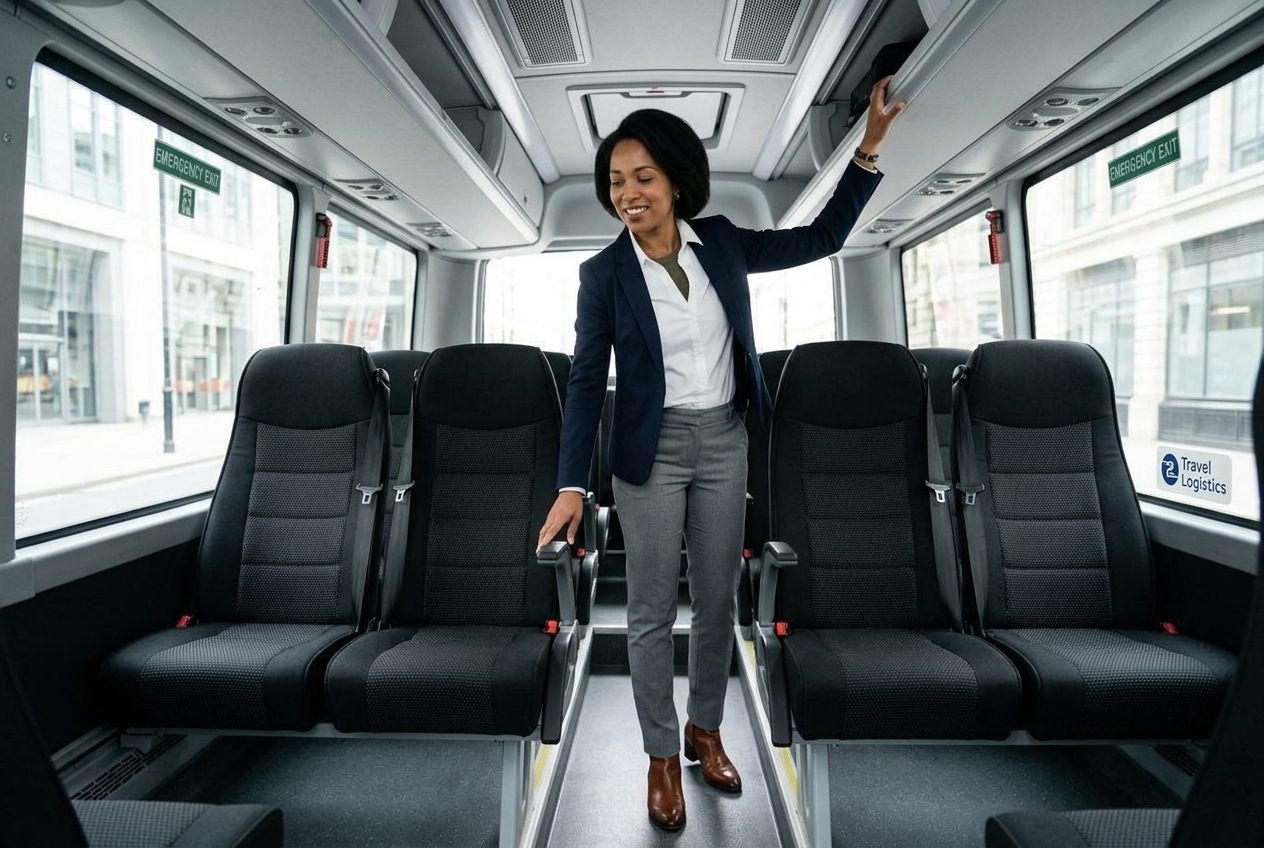
Adjustable Seats and Ample Luggage Storage
Seat adjustment matters because it supports different body types and lets passengers rest properly. Recline, armrests, and leg support reduce fidgeting and help people arrive in a better mood.
Luggage is the other half of the equation. If bags creep into the aisle, everything feels cramped and boarding becomes slow.
A practical example is a midi coach in a reduced seat layout, such as 25 passenger seats instead of 29, to create larger luggage capacity and extra legroom. That is often the right trade if your route is heavy on suitcases.
- For airport transfers: choose a layout that protects the aisle and the emergency exits, even if it means fewer seats.
- For sports teams: ask where kit bags will go and whether the rear boot stays accessible mid journey.
- For mixed age groups: prioritise easy steps, stable handholds, and seats that recline without forcing the row behind into a cramped position.
Factors to Consider for Long Distance Travel
Comfort is not just the vehicle. It is also how you plan the day.
On long routes, you need a schedule that respects driver breaks, realistic loading time, and the fact that passengers will need stops.
- Plan the break points first: DVSA guidance sets out how break requirements work for passenger vehicle driving. Build your itinerary around those stops.
- Choose a vehicle that fits your luggage: do not rely on making it work on the morning of travel.
- Check city access rules: confirm ULEZ and LEZ compliance before you accept a central hotel or venue pick-up.
- Confirm who manages the route: for minibus hire with a driver, ask whether the operator plans the route and stop strategy or expects you to direct it.
Group Size and Seating Capacity
Seat count is easy to compare. The comfort impact is easy to underestimate.
A 16 seat minibus is a common middle ground because it can carry a proper group while still feeling manageable on UK roads, especially for London drop-offs and tighter venue access.
| Group Size | Common Vehicle Choice | Comfort-First Reason |
| 1 to 8 passengers | Executive people carrier (often sold as an 8 seat plus driver layout) | More personal space, quieter cabin, quicker boarding for business travel. |
| 9 to 16 passengers | Minibus (coach style seating available) | Coach style seating becomes available, with a rear luggage area and better cabin systems. |
| 17 to 29 passengers | Midi coach (common for UK day trips) | Better luggage solutions and more consistent airflow to all rows. |
| 30 to 39 passengers | Larger midi coach | Touring comfort without stepping up to full size coach length. |
| 43 to 53 passengers | Full size coach | Best for large group travel with luggage, comfortable legroom and onboard facilities. |
If you are considering self drive, check licensing early. GOV.UK notes that minibus rules can depend on when you passed your test and whether the trip is for hire or reward, so many groups choose a driver led hire for simplicity.
Fuel Efficiency and Travel Duration
Fuel efficiency matters, but on long trips you feel the comfort impact of drivetrains more than you notice a small fuel difference.
On larger vehicles, transmission choice can affect smoothness and running costs. Automatic transmissions in city bus use have been shown to deliver meaningful fuel savings while also improving passenger comfort through smoother gear changes.
- Ask what you are paying for: a newer Euro 6 or Euro VI vehicle often costs more, but it may avoid charges and access issues in regulated zones.
- Prioritise smoothness for passenger comfort: a well driven automatic can reduce stop-start jolts that cause fatigue and travel sickness.
- Plan stop strategy around passengers: even if the vehicle can run longer between stops, people usually cannot.
Conclusion
Minibuses can be very comfortable for long trips, as long as you pick the right layout and specification, not just the right badge.
For minibus hire in London, Edinburgh, and Glasgow, check emissions compliance early, then focus on seating, cabin airflow, and a luggage plan that keeps the aisle clear.
If you do that, your group travel, airport transfers, and longer motorway runs will feel calmer, and your passengers will step off the vehicle in better shape for whatever comes next.
Ready to book? Contact London Minibus Hire today to discuss the right vehicle for your route.
Frequently Asked Questions
Are minibuses comfortable for long trips?
Yes, minibuses can be very comfortable for long trips when they are specified correctly. The key factors are roomy reclining seats, decent legroom, a climate control system that reaches every row, and good ride quality. At London Minibus Hire, we help you match the right vehicle to your route so every passenger arrives comfortable.
Are minibuses always cramped and noisy?
Not at all. That is a common myth. Many modern minibuses have improved suspension systems, better sound insulation, and properly designed passenger conversions. The quality varies significantly between operators and vehicle ages, so it is worth checking the specific model and conversion before you book.
How can I make a long minibus journey more comfortable?
Pick a minibus with reclining seats and air conditioning that covers every row. Bring a small cushion and a travel blanket for personal comfort. Ask your operator about regular stops for leg stretches and fresh air. For longer motorway routes, ask London Minibus Hire to plan sensible break points into the schedule.
Which seat should I pick for a long trip?
Choose a mid row seat with more legroom if possible, near a window for natural light and airflow. Avoid the very back row on a long journey if the route includes rougher roads, as rear bench seating can feel bouncier near the axle.
Do I need to worry about ULEZ or LEZ compliance when booking a minibus in London or Scotland?
Yes, this is an important check. Transport for London lists ULEZ requirements for minibuses up to 5 tonnes as Euro 6 for diesel and Euro 4 for petrol. In Scotland, Edinburgh enforcement began 1 June 2024 and Glasgow enforcement began 1 June 2023. London Minibus Hire operates compliant vehicles so you can travel into city centres without access issues or additional charges.
How many passengers can a minibus comfortably carry on a long trip?
For genuine long trip comfort, a 9 to 16 seat minibus works well for small to medium groups, a 17 to 29 seat midi coach is better for larger parties where luggage matters, and a full size coach suits groups of 43 to 53. The right choice depends on your passenger count, luggage volume, and the specific route. London Minibus Hire can advise on the best match for your journey.
MORE POSTS:
How far in advance should you book a minibus in London?